
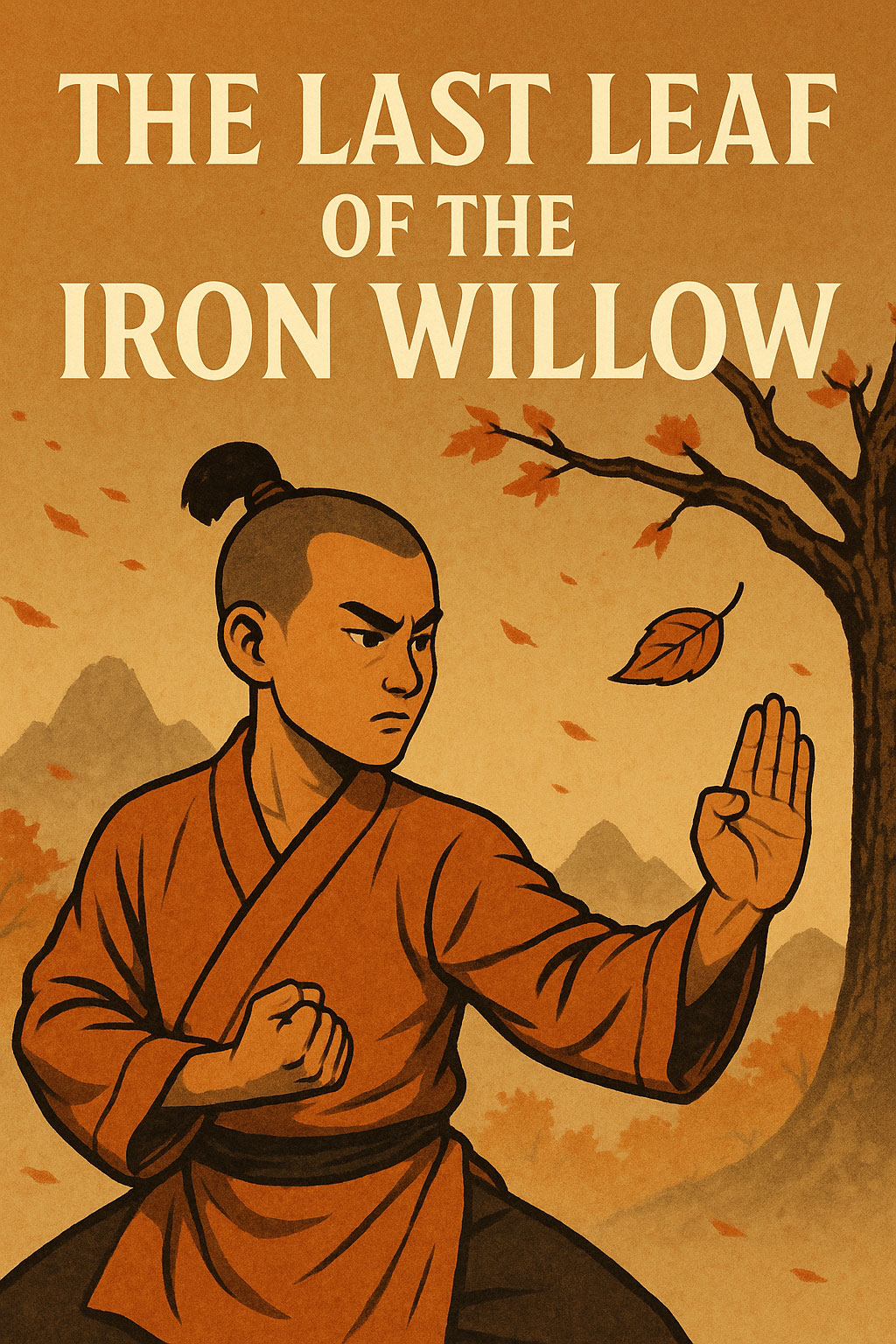
In a quiet valley nestled between snow-capped mountains of ancient China, there lived a young orphan named Wei. Raised by monks in the Temple of the Iron Willow, he was quiet, disciplined, and often found staring at the ancient tree in the courtyard—the Iron Willow, said to have been planted by the temple’s founder centuries ago.
The monks taught Wei the art of Kung Fu, not just as a way of fighting, but as a way of life. His master, Shifu Liang, often reminded him,
“Kung Fu is not in the fists, but in the breath between thoughts, the strength between storms.”
Wei trained every morning before sunrise, practiced with flowing forms during the day, and meditated by the Iron Willow at dusk. He moved like water, thought like fire, and struck with the precision of a falling leaf.
But peace does not last forever.
One winter, a band of mercenaries led by a warlord named General Bai descended upon the valley, demanding tribute from the villagers and threatening to burn the temple if denied. The monks, pacifists by vow, refused to resist.
Wei couldn’t accept it. He asked Shifu Liang for permission to fight.
“You are not ready,” the master said. “Your heart still moves faster than your mind.”
That night, Wei stood under the Iron Willow, snow falling around him, and noticed a single leaf still clinging to its branch. In that still moment, he understood.
The next morning, when General Bai’s men came, Wei stepped out alone.
The villagers watched, expecting slaughter. But what they witnessed was poetry.
Wei used not brute force, but perfect timing and technique. He turned the attackers’ weight against them, deflected blades like the wind brushing aside petals. He moved like the leaf that falls—not with panic, but with purpose.
When General Bai confronted him, the two clashed like fire and steel. Wei was thrown, struck, cut—but he remembered the leaf.
He stopped fighting. He breathed.
When Bai struck again, Wei caught his arm mid-strike, looked into his eyes, and said:
“You carry war in your fists. I carry peace in mine. You will lose.”
With a final, silent motion, Wei redirected the warlord’s energy into the earth. Bai fell, defeated not by power, but by presence.
Afterward, the villagers rebuilt. The monks renamed Wei “The Leaf of the Willow,” a master who had learned to bend without breaking.
He never left the valley again—but travelers who came through told tales of the boy who fought an army and won, not with rage, but with stillness.
And every winter, one leaf still clung to the Iron Willow.